
Replace or layer on top: when to migrate off a legacy ERP and when to add agents to what you already run
Companies running an ageing ERP face a choice that is easy to frame badly. Either spend years and a large budget replacing it, or live with it forever.
Companies running an ageing ERP
face a choice that is easy to frame badly. Either spend years and a large
budget replacing it, or live with it forever. There is a middle path: leave the
system of record in place and add AI agents on top to take over the manual work
around it. Neither answer is right for everyone, and the honest way to decide
is to look at where the pain actually comes from.
When layering makes sense
- The core still works. The ERP handles transactions, finance and compliance reliably, and users trust its numbers.
- The pain sits around the system. The effort is in re-keying data, reconciling spreadsheets, chasing approvals and building reports, not in the transactions themselves.
- A full migration would be disruptive. The business can't spare the people, or a critical period such as year-end, a merger or an audit makes a cutover risky.
- Customisation runs deep. Years of tailored workflows and integrations would be expensive to rebuild, and some of that logic may no longer be documented anywhere.
- You need results soon. Agents can deliver visible improvements in weeks or months, while a replacement project typically takes much longer before users see any benefit.
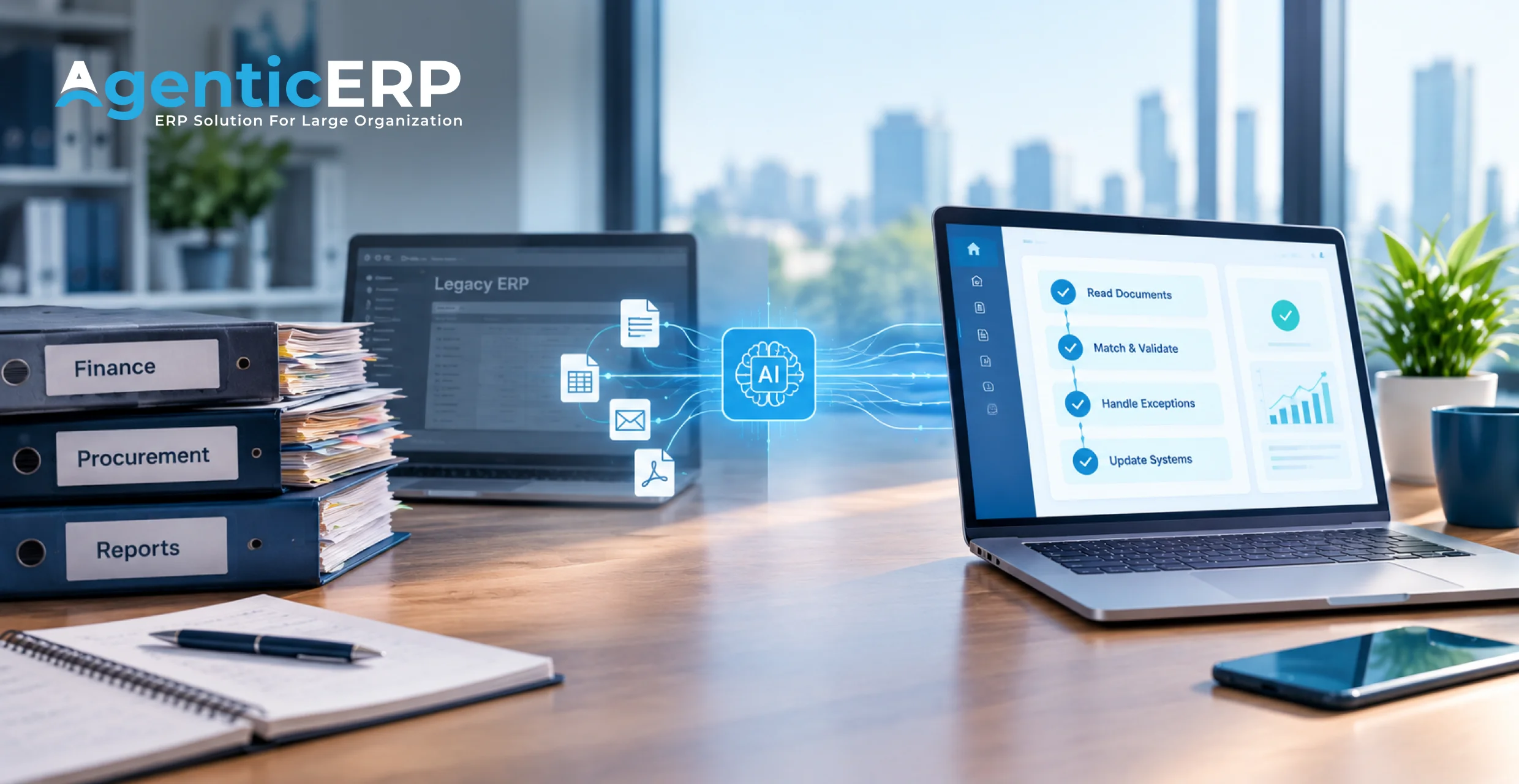
Agents can read documents, move
data between systems, flag exceptions and prepare entries, working through the
interfaces the legacy system already exposes.
When replacement is the better call
- Support is ending. The vendor has withdrawn or is winding down support, or security patches are no longer available. Running financial data on unsupported software is a growing risk.
- A critical capability is missing. The system can't support something the business now needs, such as e-invoicing compliance, multi-entity consolidation or real-time reporting.
- Technical debt dominates. Every change is slow, risky and expensive, and the few people who understand the system are a single point of failure.
- Data quality is poor. If master data is inconsistent or duplicated, agents will simply automate bad inputs faster. Fix the foundation first.
- The workaround bill has overtaken the replacement bill. When the true cost of keeping the system alive, including manual effort and external support, exceeds the cost of moving, the decision is already made.
A practical way to decide
- List the processes causing the most manual effort, delay or error.
- For each, ask the root cause. Is it a capability gap in the ERP, or a lack of automation around it?
- If most are automation gaps, layer agents and measure the results over a quarter.
- If most are capability gaps, plan a migration, and use the layered phase to clean data, document processes and reduce the scope of what must move.
Layering isn't always a
permanent state. It can buy time, free up the team and reduce migration risk by
exposing messy data and undocumented processes before the big project begins.
Watch for integration risk
Agents are only as reliable as
their connections. Check that interfaces or APIs are stable and supported, that
permissions follow least-privilege principles so an agent can only touch what
it needs, and that you have a rollback plan if the legacy system is patched or
changed. Treat the integration layer as production infrastructure, with
monitoring and ownership, not as a side project.
Involve finance and IT early
Both paths touch controls,
audit and data protection. Bringing finance, IT and internal audit into the
decision from the start avoids surprises later, and it gives the business a
shared view of what success looks like and how it will be measured.
Why choose AgenticERP
AgenticERP can run as the
system of record or as an agentic layer over the ERP you already have, so you
can start with the highest-effort processes and move further when the business
case is clear. The same agents and audit trail carry across both paths, which
means early work isn't thrown away if you later decide to migrate.
AgenticERP is an agentic AI ERP that lets enterprises modernize in stages, whether they replace their legacy system or build on top of it.