
Why Source Code Ownership Matters When You Choose an ERP
It's a normal arrangement, and rarely questioned closely until it actually matters: a business licenses an ERP for years, pays for it continuously and often substantially, and at no point in that relationship actually owns anything.
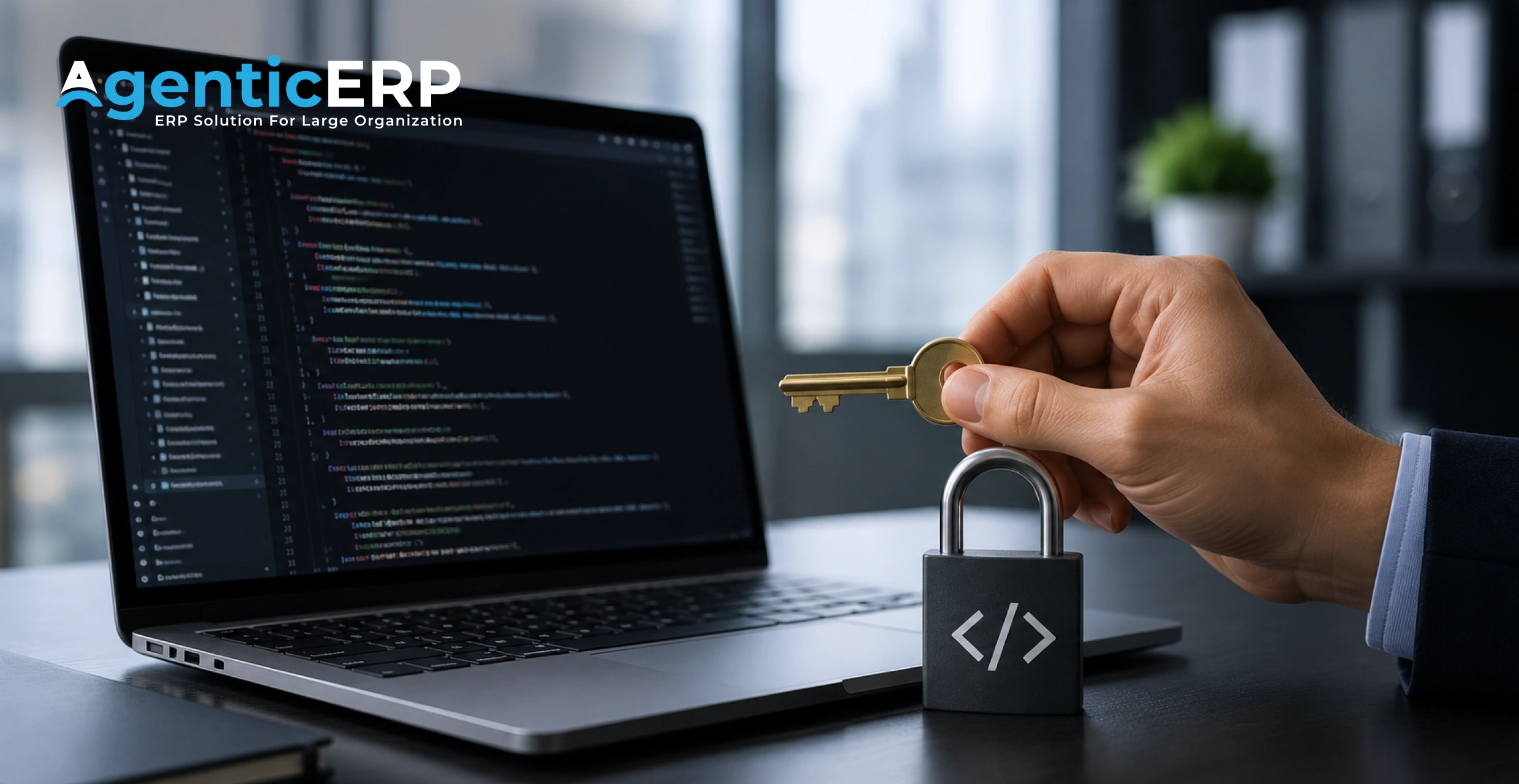
If the contract ends — through choice, through non-renewal, or because the relationship simply breaks down — access ends with it. If the vendor changes strategic direction, gets acquired by a competitor, or simply deprioritises a feature the business has come to depend on operationally, there is no real recourse beyond negotiation, because there is nothing to fall back on except the ongoing goodwill of the relationship itself.
What vendor lock-in looks like in practice
Lock-in rarely announces itself as a crisis, and that's precisely what makes it dangerous — it accumulates gradually rather than arriving as a single decision point a business can push back against. It shows up as a product roadmap that no longer matches what the business actually needs, a renewal quote that increases faster than the demonstrable value the system delivers, or a customisation request that simply can't be built because it falls outside what the vendor is commercially willing to support for a single customer. At that point, switching costs — data migration, staff retraining, weeks of process disruption during transition — are usually high enough that most businesses choose to stay and absorb the unfavourable terms rather than undertake a full system change.
What ownership actually unlocks
Full source code ownership changes the shape of that relationship fundamentally, not just at the margins. Structural customisation — the kind that goes well beyond configurable screens, fields and workflows into how the system actually behaves at a deeper level — becomes possible without needing anyone's permission. Any competent development team, whether that's an internal engineering group or a completely different external vendor, can maintain and extend the system going forward. There is no forced upgrade cycle dictated by someone else's product release calendar, and critically, nothing stops working the day a support contract happens to lapse, because the code itself doesn't depend on an active relationship to keep functioning.
Ownership paired with deployment choice
Ownership matters most in practice when it's paired with genuine deployment flexibility rather than existing as a theoretical right. A system that can run in a UAE-hosted managed cloud, inside a business's own AWS, Azure or Oracle tenancy, or fully on-premise and air-gapped where required — all under precisely the same licence — gives a business real control over both the code itself and where it physically executes and stores data. For finance-driven, compliance-critical organisations operating under sector regulation or government contract requirements, that combination is usually non-negotiable rather than a preference to be traded off against other features.
A practical due-diligence question
Any procurement or legal team evaluating an ERP vendor should ask a direct question early in the process: if this relationship ends in five years, what does the business retain? For most SaaS vendors, the honest answer is very little beyond an exported dataset. For a vendor offering genuine source code ownership as part of the licence, the answer is the entire working system — a materially different risk position for a decision that will shape how a large enterprise operates for the next decade.
Ownership and the AI layer specifically
This question matters even more once AI agents are part of the system, because a business that doesn't own its ERP typically has even less visibility into how the AI layer sitting on top of it actually works — what data it reads, what rules it applies, whether its recommendations can be audited on demand. Owning the source code, including the agent layer itself, means a business's own risk, compliance or internal audit function can genuinely inspect how a recommendation was reached rather than trusting a vendor's description of it, which matters considerably to a board approving autonomous or near-autonomous financial actions.
What this means for a growing group specifically
For a group that's actively acquiring entities or expanding into new markets, source code ownership also removes a subtler risk: the possibility that a vendor's own commercial priorities shift toward a different customer segment as the vendor grows, leaving a long-standing customer's specific needs increasingly deprioritised on the roadmap. An owned system doesn't drift with someone else's strategy — it stays exactly as customisable and as maintained as the business chooses to keep it, on its own timeline.
Reading a vendor's contract, not just its pitch
Ownership claims are worth verifying in the contract itself rather than taking at face value from a sales conversation, because the language vendors use here varies more than it should. "Access to source code" for troubleshooting purposes is a materially weaker commitment than an outright transfer of ownership with the right to modify, redistribute internally and maintain independently. A procurement team should expect the contract to state plainly what happens to the code on day one of the licence, not only what happens if the vendor eventually goes out of business — because the more common scenario, by far, is simply outgrowing a vendor relationship that's otherwise still operating normally.
Why Choose AgenticERP
AgenticERP includes full source code ownership with the perpetual licence — your team or any vendor can maintain and extend it, and nothing stops working if the relationship with the vendor ends. That ownership sits alongside real deployment choice: UAE-hosted cloud, your own AWS, Azure or Oracle tenancy, or fully on-premise, with no change to the licence. Combined with a one-time ERP licence, unlimited users and the 44 AI agents included at no extra charge, it's built for large UAE and GCC groups who don't want to renegotiate their ERP relationship every renewal cycle. Book a 30-minute demo to see the codebase and deployment options.