
ERP Deployment Options for the UAE: Cloud, Private Cloud, or On-Premise
Where an ERP system actually runs is rarely a purely technical decision for a business operating in the UAE.
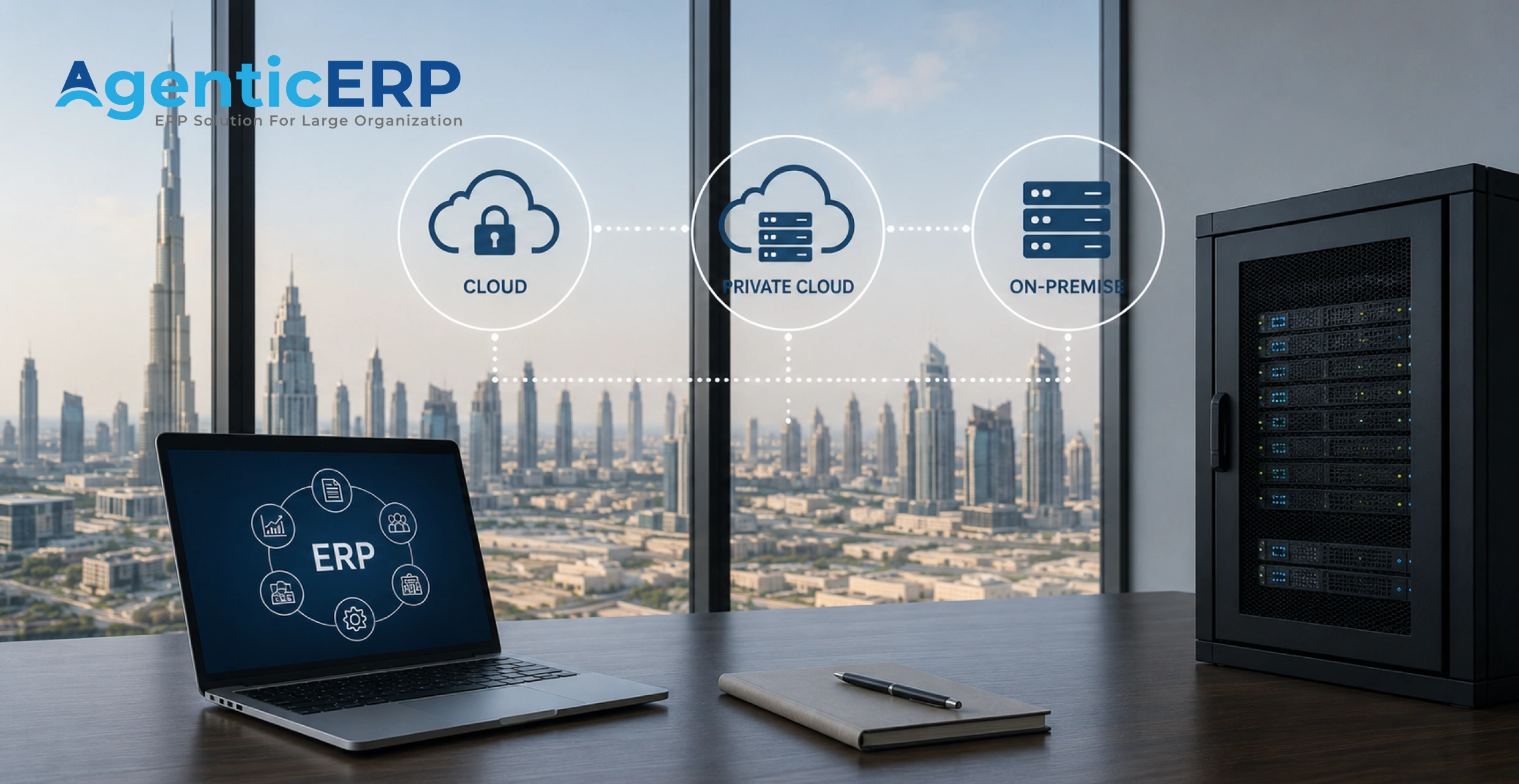
Data residency requirements, sector-specific security policy, and board-level risk appetite all shape the answer well before IT preference or convenience even enters the conversation in a meaningful way. A deployment decision made for short-term convenience today can quietly become a serious compliance problem later if the underlying architecture doesn't allow it to be reversed without significant disruption.
UAE-hosted managed cloud
For a large proportion of businesses, a managed deployment inside a UAE data centre represents the right balance between operational simplicity and control. Backups, patching and monitoring are handled by the provider as part of the service, data stays within the country in line with common regulatory expectations, and the internal IT team isn't carrying infrastructure responsibility it doesn't have the specialised headcount or expertise to manage safely and efficiently on its own.
Your own cloud tenancy
Larger enterprises that already maintain a substantial AWS, Azure or Oracle relationship often prefer to deploy their ERP into that existing tenancy, operating under their own established security policy and governance structure rather than adopting a new set of vendor-specific controls. This approach keeps the ERP inside a security perimeter the business already actively manages, monitors and audits as part of its broader IT estate, rather than adding an entirely new external vendor relationship and a new set of assumptions to that perimeter.
Fully on-premise
For organisations where data genuinely cannot leave a defined physical boundary under any circumstance — often driven by sector-specific regulation, defence-adjacent work, or government contract requirements that are simply non-negotiable — a fully on-premise deployment, air-gapped if required, is the only acceptable option available. Critically, choosing this route shouldn't mean settling for older technology, reduced functionality, or a degraded user experience compared to a cloud deployment; the same system, the same feature set and the same licence should apply regardless of where it physically happens to run.
Where AI agents fit into a strict data policy
Deployment choice matters even more once AI agents enter the picture, because agents read continuously across finance, operations and HR data as part of doing their job — they aren't a bolt-on tool that touches data occasionally, they're watching transactions constantly. For businesses that cannot allow that data to leave their network under any circumstances, running the underlying agent models entirely inside the business's own infrastructure — so that prompts, documents and results never leave the network at any point — removes the concern structurally, rather than requiring a special policy exception to be negotiated and continually justified to an internal risk committee.
Security controls that apply regardless of deployment choice
Whichever deployment model a business chooses, the same layer of security controls should apply underneath it without exception: single sign-on with SAML and Azure AD support, multi-factor authentication, role and entity-level permissions, formal segregation of duties, encryption both at rest and in transit, and an immutable audit trail covering every action taken by a person or an agent. Treating these as universal rather than deployment-specific means a change in hosting strategy later — moving from managed cloud to on-premise, for example, as a business's risk posture evolves — doesn't also require rebuilding the security model from scratch.
Deployment as a decision that can change over time
A business's deployment needs at the point of ERP selection are rarely its deployment needs a decade later. A company that starts on managed cloud because it doesn't yet have the internal infrastructure team to run anything else may well want to move to its own tenancy once that capability exists in-house, or a business that wins a government contract midway through its ERP lifecycle may suddenly need an on-premise option it didn't require at signing. Because the licence itself doesn't change across deployment options, that transition is a hosting decision rather than a full system replacement — a materially easier conversation to have with a board than migrating to an entirely different ERP because the original vendor only supported one deployment model.
What to actually ask during a security review
A useful test during vendor evaluation is to ask specifically how AI agent activity is logged, not just how user activity is logged — many vendors have a mature answer for the first and a much thinner one for the second, because agent-driven actions are newer territory for most audit and compliance teams to have tested thoroughly. An audit trail that treats an agent's proposed action, the evidence behind it, and the human approval that followed as a single traceable record is a meaningfully higher bar than one that only logs the final transaction once it's posted.
Balancing IT preference against board-level risk appetite
It's common for an internal IT team to have a natural preference for one deployment model, often shaped by whatever infrastructure they're already most comfortable operating, while the board's actual risk appetite points somewhere else once data residency and sector regulation are properly weighed. Making deployment a genuinely open decision — rather than one implicitly constrained by whichever option the ERP vendor happens to support well — means that conversation can be resolved on its actual merits, with IT preference as one input rather than the deciding factor by default.
Why Choose AgenticERP
AgenticERP runs the same licence across three deployment options — UAE-hosted cloud managed by Royex, your own cloud tenancy, or fully on-premise — with no change to functionality or pricing. For enterprises with strict data policy, the AI agent models can run entirely inside your infrastructure, so prompts, documents and results never leave your network. Every action — human or agent — sits behind SSO, MFA, segregation of duties and an immutable audit trail, and the same system covers UAE VAT, FTA e-invoicing and WPS compliance out of the box. Book a 30-minute demo and ask specifically about your deployment constraints.