
Manufacturing ERP: Cutting Scrap, Downtime and Stock-Outs with AI Agents
Most manufacturers don't lose money in one dramatic event. They lose it in small, recurring places: scrap absorbed into standard cost and never questioned
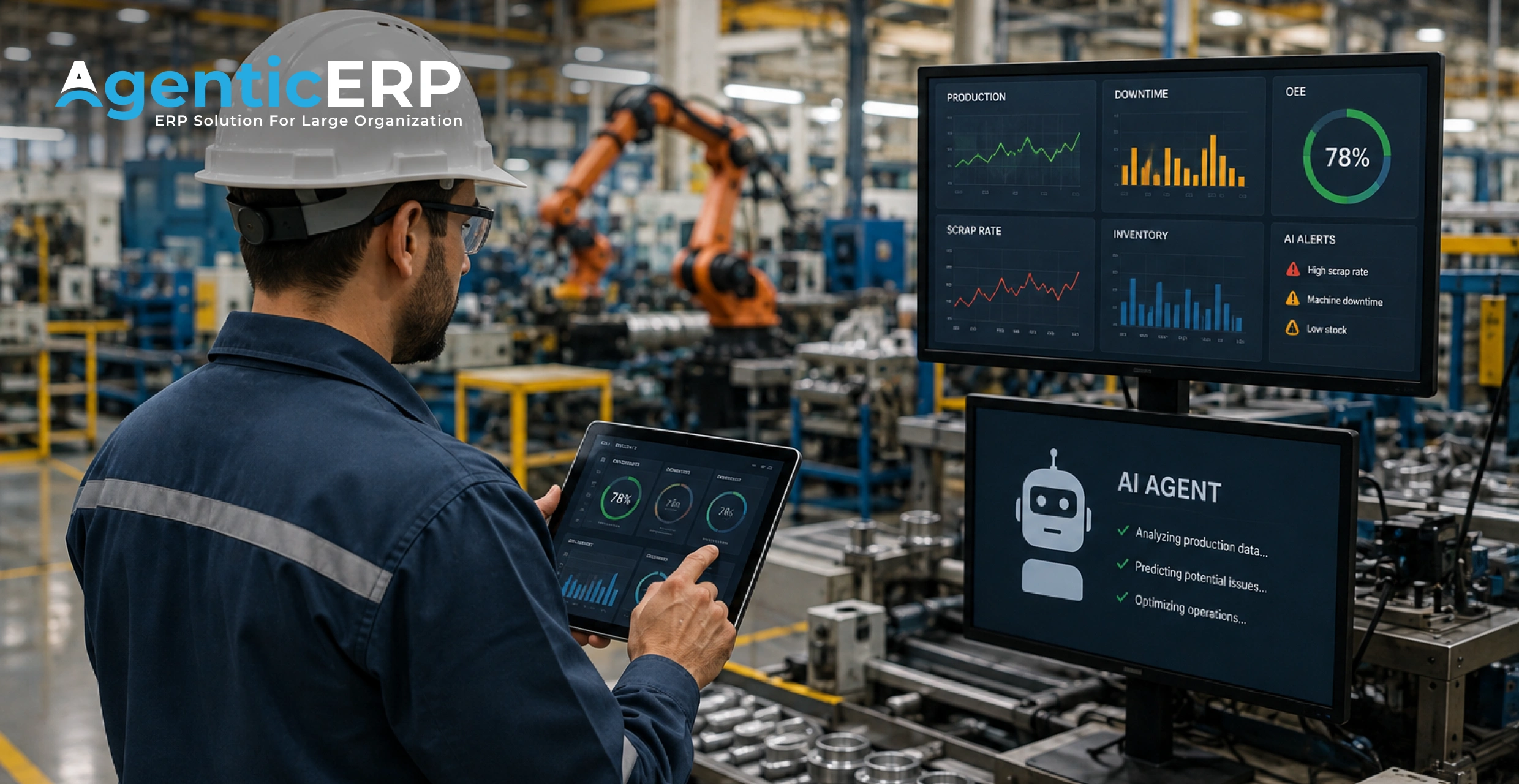
A machine that fails without warning, a raw material that runs out because nobody was watching the supplier's lead time, and job costs that only close weeks after the order has already shipped. Individually, each of these looks like the ordinary cost of doing business. Added up across a year, they are usually the single biggest gap between the margin a factory reports and the margin it actually made.
A traditional MRP system records these events after they happen. It tells you a work order was late, not why it was late. It tells you material ran short on the day the line stopped, not six days earlier when the warning signs were already sitting in the data — a supplier's on-time delivery rate slipping, consumption creeping up, safety stock quietly eroding order after order. By the time a human notices, the cheapest and least disruptive window to fix the problem has already closed.
Where the money actually leaks
Scrap is the most familiar leak and the hardest to see in aggregate, because it's usually reported as a percentage against standard cost rather than compared shift-to-shift or line-to-line. A two or three percentage point gap between the best-performing shift and the worst rarely triggers an investigation on its own, even though, multiplied across a year of production, it can represent a meaningful share of gross margin. Unplanned downtime behaves the same way: it's budgeted for as a fixed percentage of capacity rather than actively reduced, because nobody is watching individual machines closely enough to predict failure before it happens. And raw material stock-outs are treated as a supply chain problem when they're often actually a data problem — the warning signs exist well before the shortage bites, they're just not being read continuously.
What changes with an agentic layer
An agentic AI ERP watches the same transactions a standard system records, but it reasons over them continuously instead of waiting for someone to run a report. ProductionBrain sequences work orders across the plant and reschedules automatically around a maintenance window, rather than leaving a planner to manually juggle a whiteboard. MRPCopilot runs MRP the way any ERP does, but it also explains — in plain language, not a log file — why a particular work order moved and what specifically drove the change, so a planner can trust the output instead of re-deriving it by hand. MaintenancePredictor watches condition data from equipment and books a bearing replacement or similar intervention eleven days before the predicted failure, sequenced so it doesn't collide with a production run. YieldOptimiser compares scrap and yield rates across shifts, lines and even operators, and surfaces a gap.
A worked example: catching a stock-out six days early
SupplySync is usually the agent that earns its place fastest on a shop floor, because the failure mode it prevents is so visible and so expensive when it happens. In a typical case, it predicts that a specific raw material will stock out in six days. It doesn't just raise an alert — it names the cause: a supplier's lead time has crept up 40% across the last three purchase orders, a trend a human reviewing POs individually would likely miss. It quantifies the impact in terms that matter commercially: two production orders at risk, worth a specific value in AED. And it doesn't stop at diagnosis. It drafts the fix — raise a purchase order with an alternate, already-approved supplier at a small cost premium, transfer four hundred units from another warehouse, notify the production planner directly — all before a human has to do anything except review and approve. The action is logged, reversible if needed, and closed out once the risk is resolved.
Why this matters for job costing, not just operations
The reason this matters beyond the shop floor is that these agents sit inside the same ERP modules as finance and procurement — not a separate manufacturing execution system that has to be reconciled with the ledger later. Batch costing and work-in-progress update live as production happens, so margin per order is known the day it ships, not three weeks later when an accountant finally reconciles the shop floor against the books. That single structural change — one ledger instead of two systems talking to each other on a delay — closes most of the gap between what a factory believes it made and what it actually made, and it does so without requiring anyone to build a new reporting process on top of what already exists.
Setting the right level of autonomy on the shop floor
None of this requires handing full control of the plant to software on day one, and most manufacturers wouldn't want that even if it were offered. Each agent can be set to suggest-only, approve-then-act, or fully autonomous, with limits set per agent, per entity and per value threshold — so MaintenancePredictor might be trusted to book a routine service slot autonomously while a recommendation to switch suppliers on a high-value raw material stays firmly in approve-then-act mode until the plant manager has built confidence in the pattern. Most manufacturing teams start conservatively across the board and loosen specific limits only once an agent has demonstrated it reliably gets a specific type of call right, which tends to happen faster than expected once the evidence behind each recommendation is visible rather than a black-box output.
What implementation actually looks like for a plant
For a single-plant manufacturer, moving onto a system like this typically starts with a process walkthrough of existing BOMs, routings and the current maintenance schedule, followed by a data migration that reconciles opening stock and work-in-progress to the last audited numbers before anything goes live. Agents start in suggest-only mode during the first weeks after go-live, so the plant team can see what SupplySync or MaintenancePredictor would have flagged without any risk of an incorrect autonomous action, before autonomy limits are gradually opened up as trust in the recommendations builds through direct experience on that specific plant's data.
Why Choose AgenticERP
Most manufacturing ERPs record what already happened on the shop floor. AgenticERP's AI agent fleet — including ProductionBrain, MRPCopilot and MaintenancePredictor — sequences work orders, predicts machine failure before it happens, and flags material shortages days in advance with the evidence attached. It runs on the same ERP modules as finance and procurement, so a shop-floor delay shows up in cost and cash immediately, not at month-end. Licensing is a one-time ERP licence with unlimited users — add a second or third plant without a per-seat bill. See how it fits manufacturing, trading and contracting businesses specifically, or book a 30-minute demo on your own BOM and routing data.